
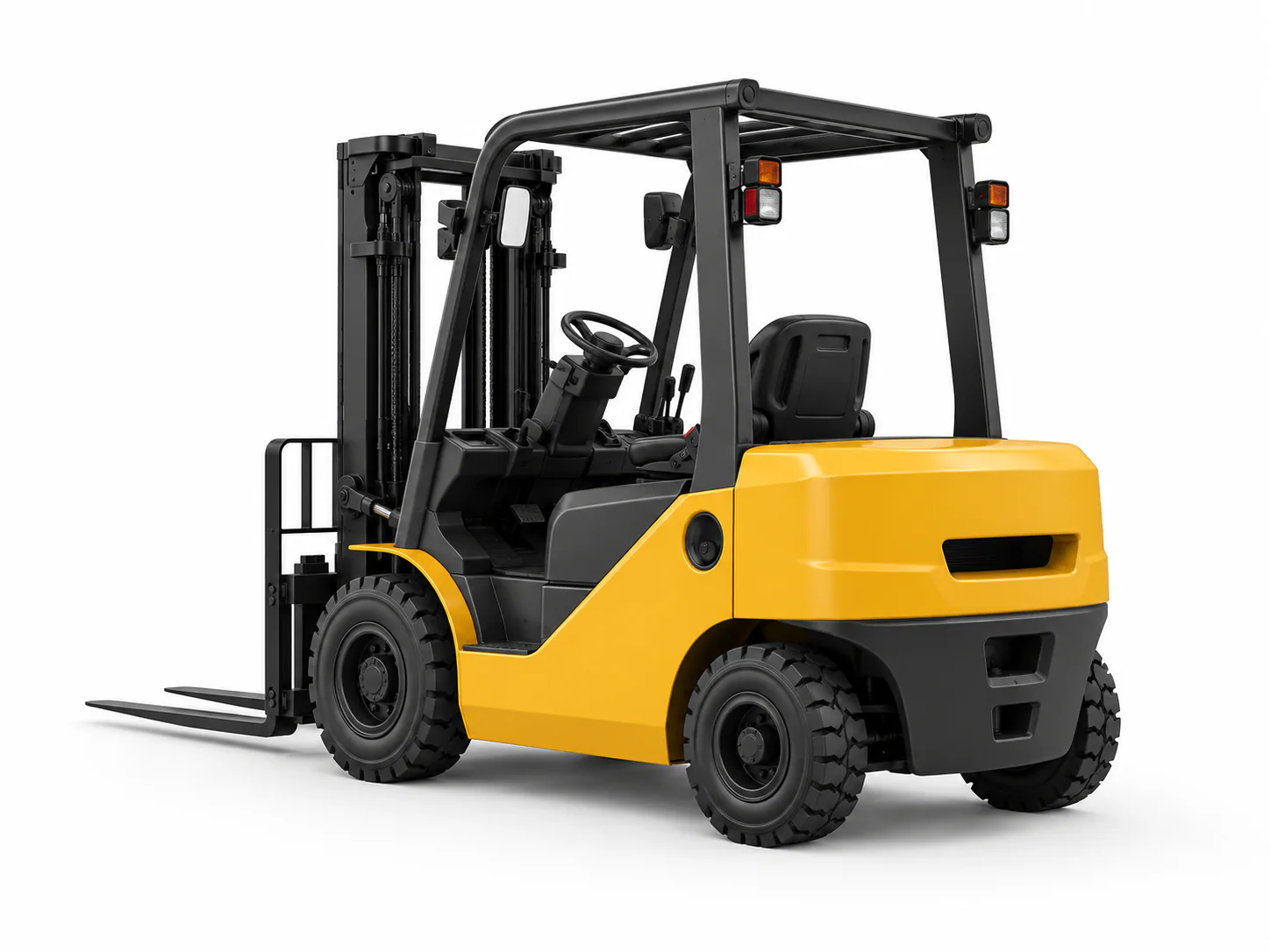
Cameras are not universally standard equipment on forklifts. Availability depends on the manufacturer, model, configuration, application and optional equipment package. Some trucks have factory-installed cameras; others can be ordered with an optional package or evaluated for an aftermarket system. The sources reviewed here do not establish whether a majority of forklifts have cameras, so there is no reliable adoption percentage to quote. For a fleet buyer, the useful next question is which view the operator needs: the rear travel area, the forks and pallet, or another specific obstruction.
Do Forklifts Come with Cameras from the Factory?
Check the build specification for the individual forklift. A camera shown in a brochure or on a demonstration truck does not establish that it is standard on every model. A vehicle display may show operating information without accepting an added camera input.
For a concrete manufacturer example, Toyota's Reach Truck specification sheet lists a camera system and camera system cable under optional equipment. This is evidence for that documented range, not a statement about every Toyota truck or the US installed fleet. Confirm current availability with the manufacturer or dealer.
Swipe left or right to view all columns.
| Configuration | Description | What the buyer should check |
|---|---|---|
| Factory-installed camera | Installed during vehicle production, either as standard equipment or as an ordered option | Exact build specification, intended view and factory support |
| Optional factory package | Available for selected models or configurations; may also be installed during production | Model availability, included components and integration |
| Aftermarket camera system | Added after vehicle delivery | Mounting, power, display, signal compatibility and installation approval |
The first two categories can overlap: factory-installed describes when the equipment is fitted, while optional describes how it is specified. An older forklift or mixed fleet may need an aftermarket arrangement when the existing equipment does not provide the required view. See our forklift application page for the supported planning context.
Why Do Forklifts Need Camera Systems?
Forklifts do not all need the same camera layout. Start by naming the detail that is difficult to see from the normal operating position. Rear travel visibility and pallet alignment are different tasks, even when both involve the same vehicle.
- Reversing: the counterweight, nearby racks or stored goods can restrict parts of the rear view.
- Mast visibility: mast members and attachments can interrupt the view of the handling area.
- Load obstruction: a wide or tall load can block forward sightlines.
- Fork positioning: fork tips and pallet openings may be difficult to judge, particularly at height.
- Aisles and loading zones: a chosen camera angle can show a defined area, but racks, corners and changing loads can still obscure other areas.
A forklift safety camera is a supplemental visual aid. It does not replace training, direct observation, mirrors or site procedures. Under OSHA 29 CFR 1910.178(n)(6), operators must look toward their direction of travel and maintain visibility along the route. Paragraph (n)(4) addresses slowing and sounding the horn where sight is obstructed, and traveling with the load trailing when it blocks the forward view. These provisions do not establish a universal camera mandate or authorize substituting a monitor for those operating requirements.
What Types of Cameras Are Used on Forklifts?
Rear-View Cameras
A forklift backup camera looks toward the area behind the truck. Choose its location by what the operator must see near the rear, rather than simply fitting it to the easiest available surface. Check the view with the usual attachments and loads in place.
Forklift Mast Cameras
A forklift mast camera supports a load-handling view. A camera on a mast member and one on the moving carriage do not follow the load in the same way. Near-fork placement also needs clearance from pallets and rack structures. Our mast and carriage placement guide covers those choices in detail.
Side-View Cameras
A side view may help with a specific obstruction around the truck or attachment. Define the required side area and review the view through steering and handling movements. A side camera should not be described as complete coverage around a corner or through racking.
Wireless Forklift Cameras
Wireless describes the video connection, not the viewing position. A wireless camera still needs an approved location and power. It may be considered for a rear, mast or other defined view if the selected hardware and installation suit that task. These camera categories are possible applications, not a list of cameras included in our kit.
How Do Aftermarket Forklift Camera Systems Work?
The basic video path is camera → wireless transmitting link → receiving monitor → operator view. Transmitter and receiver functions may be built into the camera and display; do not assume a separate external box is required or included. Mounting accessories hold the equipment in position, while power must be arranged for both ends of the link.
Using our wireless forklift system as an example, the camera sends video over a 2.4G wireless AHD digital connection to the receiving display. Automatic pairing supports setup. The display can accept up to two compatible wireless camera signals and use single-channel or two-way split-screen presentation.
There are two separate planning paths:
Swipe left or right to view all columns.
| Path | Arrangement to review | What it does not establish |
|---|---|---|
| Video | Camera and wireless transmission to a compatible receiving display | Reception throughout the actual warehouse route |
| Power | Camera mobile battery plus the specified system supply connection | Battery runtime or the input rating of every individual component |
Wireless video can remove a long video cable from the proposed route. It does not remove battery servicing, display power or mounting checks. Review the wired versus wireless comparison for the installation tradeoffs.

What Should You Consider When Choosing a Forklift Camera System?
Write a viewing requirement before choosing hardware: for example, a rear area beside the counterweight or pallet entry at a nominated handling height. Then use the same requirement for the supplier discussion and sample review.
Swipe left or right to view all columns.
| Selection factor | What to verify |
|---|---|
| Camera position | Required rear, mast, fork or side detail; view with typical loads |
| Signal transmission | Wired or wireless architecture, matching video format and receiver |
| Power supply | Measured supply at the intended connection, component ratings and battery charging plan |
| Display | Actual screen size, readable detail in single and split views, and position clear of controls and direct sightlines |
| Camera quantity | Required views, supported signals and the camera count included in the quotation |
| Mounting | Suitable magnetic surface or other approved mount, retention and movement clearance |
| Environment | Lighting, cleaning, temperature and required component protection evidence |
| Compatibility | Camera, display, power, pinout and connectors as a complete assembly |
Connector appearance alone does not establish electrical or video compatibility. For a retrofit that affects capacity or safe operation, OSHA 1910.178(a)(4) requires prior written manufacturer approval and corresponding updates to the relevant plates, tags or decals. Involve the vehicle manufacturer when assessing those effects.
For sample acceptance, agree on what must remain visible, review the relevant lifting and steering range under controlled conditions, and check reception along representative routes. Record image interruptions, mount movement and battery service needs before approving fleet quantities. This is a proposed evaluation method, not a report of completed SuperPower testing.
Is a Wireless Forklift Camera System Suitable for Aftermarket Installation?
The SuperPower Wireless Forklift Camera System is an option for projects evaluating a wireless camera and receiving display. Its listed specifications provide a useful starting point; the target truck and worksite determine suitability.
Swipe left or right to view all columns.
| Parameter | Confirmed specification | Practical purchasing meaning |
|---|---|---|
| Wireless transmission | 2.4G Wireless AHD digital transmission | Match camera and receiver; evaluate reception in the intended setting |
| System input | DC 12–35V | Verify the actual supply and individual component requirements |
| Camera signals | Up to two wireless camera signals | Plan no more than two supported inputs; confirm supplied camera quantity |
| Display | Single-channel or two-way split screen | Compare useful image detail in the selected view mode |
| Pairing | Automatic code matching | Supports pairing; does not prove interference-free operation |
| Image orientation | Mirror or normal setting for two channels | Check displayed direction against each camera position |
| Guidelines | Adjustable electronic distance reference lines | Visual references, not a measured range sensor |
| Camera power | Mobile battery | Plan charging, retention and the required operating period |
| Mounting | Magnetic installation | Check the contact surface, secure retention and movement clearance |
A voltage example matters more than a generic compatibility promise. The Toyota Reach Truck sheet cited above lists 24V and 36V electrical configurations. Our kit's listed system input stops at 35V, so a 36V traction supply is outside that range. Even for a nominal 24V truck, check the actual accessory connection and component limits. Do not connect directly to the traction battery based only on the truck's nominal voltage.
For two viewing positions, ask the supplier to quote the required cameras and display together. Support for two signals does not mean two cameras are supplied, and a split screen does not let one camera see behind an obstruction. Similarly, magnetic mounting provides a mounting method, not proof of retention through mast movement or impacts.
No verified transmission distance, battery runtime, vibration certification or continuous mast-movement test result is offered here. The source description mentions waterproof construction but does not establish an IP67 or IP69K rating for this complete kit. It is a viewing system, with no claimed automatic collision avoidance or braking.

Frequently Asked Questions
Do all forklifts have backup cameras?
No. Check the exact model and build configuration. A camera may be standard, optional or added later; the sources reviewed do not provide an industry-wide adoption percentage.
Can you install a camera on an older forklift?
An aftermarket installation may be possible after reviewing power, mounting, sightlines, display placement and compatibility. Obtain manufacturer approval where the addition affects capacity or safe operation.
Are forklift cameras wired or wireless?
Both types exist. Wired systems use a physical video connection; wireless systems send video over a radio link. Both still need power and suitable mounting.
Where should a forklift camera be installed?
Choose the position for the viewing task: rear travel, mast or fork handling, or another specific blind area. Check the installed view and clearance on the actual forklift.
Can one forklift camera monitor multiple viewing areas?
One camera shows its own field of view. Separate areas may require additional cameras. Our listed wireless display supports up to two compatible camera signals, with single or dual views; confirm the quoted camera count.
What should I check before purchasing a forklift camera system?
Confirm the required view, vehicle model, actual supply, component compatibility, camera count, display, mounting and environment. Agree on a representative sample review before placing a fleet order.
Final Thoughts
The available evidence does not support a claim that most forklifts have cameras. Check the vehicle configuration, then select an additional view around the actual operation. Separating rear travel from fork alignment, wireless video from power, and supported inputs from supplied cameras makes the purchasing brief more precise.
For an aftermarket project, the SuperPower system's confirmed specifications can anchor that discussion. Review the complete assembly on the intended truck before deciding whether it suits the fleet.