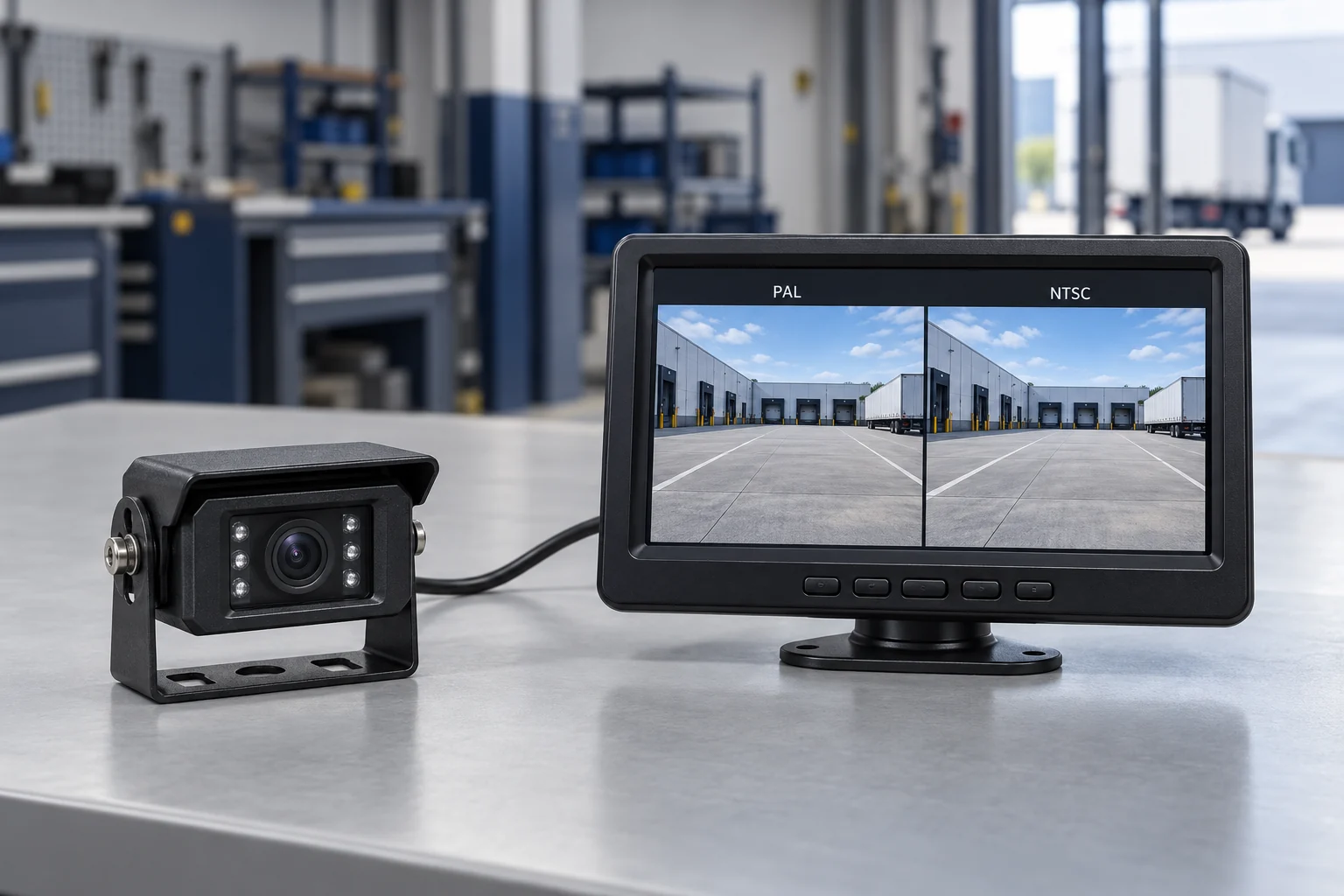
When sourcing a vehicle camera, monitor or replacement camera system, PAL and NTSC may appear as a small line in the specification sheet.
It is easy to overlook.
However, when a camera and monitor do not support the same video system—or when the equipment cannot automatically detect the incoming format—the result may be no image, an unstable picture or another compatibility problem.
For truck, bus, forklift and other commercial vehicle projects, PAL vs NTSC should therefore be treated as part of the complete system specification rather than as an isolated camera feature.
Quick Answer
PAL and NTSC are video system formats historically associated with different regional television standards.
In modern commercial vehicle camera systems, the practical question is usually not whether PAL or NTSC is universally better.
The more important questions are:
- What format does the camera output?
- What formats does the monitor or DVR accept?
- Can the receiving equipment detect PAL and NTSC automatically?
- Are the camera resolution and video signal also compatible?
- Has the complete camera-to-monitor assembly been tested?
Many modern vehicle monitors support both PAL and NTSC, sometimes with automatic detection. However, compatibility should still be confirmed for the exact models being ordered.
PAL vs NTSC at a Glance
| Item | PAL | NTSC |
|---|---|---|
| Common traditional field frequency | 50 Hz family | 59.94/60 Hz family |
| Common frame-rate relationship | Often associated with 25 fps | Often associated with 29.97/30 fps |
| Historical regional use | Many European and other markets | North America, Japan and other markets |
| Vehicle-camera relevance today | Confirm camera and monitor support | Confirm camera and monitor support |
| Better choice? | Depends on system | Depends on system |
These are common traditional interlaced-system relationships, not a universal rule for every PAL variant or modern HD mode. Field frequency is different from frame rate. Confirm the exact frame rate for the quoted camera output.
For a commercial vehicle project, region alone should not determine the order.
The actual camera, monitor and recording equipment must support the selected configuration.
What Is PAL?
PAL stands for Phase Alternating Line.
It became widely used as an analog television system in regions operating around a 50 Hz system frequency.
In vehicle-camera applications, PAL may appear in specifications for CVBS cameras, AHD cameras, monitors and DVR equipment.
A buyer may therefore see specifications such as:
- AHD 1080P PAL
- CVBS PAL
- PAL/NTSC
- PAL/NTSC AUTO
The label alone does not confirm compatibility with every monitor.
The video signal type, resolution, connector and receiving equipment must still be checked.
What Is NTSC?
NTSC is another traditional television/video system associated with a 59.94/60 Hz frequency family.
Vehicle-camera equipment intended for markets such as North America or Japan may support NTSC, although modern equipment frequently supports multiple formats.
As with PAL, an NTSC label should not be considered a complete compatibility specification.
A camera described as “NTSC” may still differ from another camera in:
- AHD or CVBS output
- Resolution
- Frame rate
- Connector pinout
- Power requirement
- Image orientation
- Cable configuration
PAL or NTSC is therefore only one part of the specification.
Is PAL or NTSC Better for a Truck Camera?
There is no universal answer.
For most commercial vehicle buyers, the correct choice is the format supported by the complete system.
If an existing truck already uses a compatible NTSC monitor, replacing one camera with the correct NTSC configuration may be the simplest solution.
If a fleet is installing a completely new system using equipment that supports PAL and NTSC automatically, the distinction may become less important operationally.
The purchasing decision should instead focus on the complete system:
Camera → Cable → Connector → Monitor or DVR
All parts should be verified together.
Does PAL vs NTSC Affect AHD and CVBS?
Yes, but PAL/NTSC and AHD/CVBS describe different parts of the video specification.
This distinction is important.
AHD vs CVBS primarily describes the type of video signal.
PAL vs NTSC relates to the video-system timing or format used by the equipment.
A camera can therefore be described with combinations such as:
- CVBS PAL
- CVBS NTSC
- AHD PAL
- AHD NTSC
In AHD datasheets, PAL/NTSC is often shorthand for the associated timing or frame-rate family; it does not mean the HD signal uses traditional composite color encoding. Specify the exact AHD resolution and frame rate, rather than relying on a PAL/NTSC label alone.
Do not treat these terms as interchangeable.
For example, changing from a CVBS camera to an AHD camera involves more than changing PAL to NTSC.
The receiving monitor must support the actual AHD signal and resolution.
For a deeper explanation, see our AHD vs CVBS vehicle camera guide.
What Happens If the Camera and Monitor Do Not Match?
Symptoms depend on the equipment.
A mismatched or unsupported configuration may result in:
- No video
- Black screen
- Blue screen
- Rolling or unstable image
- Incorrect color
- Black-and-white image
- Intermittent video
However, these symptoms do not automatically prove that PAL or NTSC is the cause.
Similar problems can also result from:
- AHD/CVBS mismatch
- Unsupported resolution
- Incorrect monitor input mode
- Wrong connector pinout
- Incorrect camera voltage
- Damaged cable
- Poor connection
- Incorrect power or ground
- An incompatible adapter
Troubleshooting should therefore begin with the complete signal path.
Do Modern Vehicle Monitors Support Both PAL and NTSC?
Many do.
Commercial vehicle monitors are now available with PAL/NTSC automatic detection, and some also support multiple AHD and CVBS input formats.
This can make international product configuration and replacement projects easier.
But “PAL/NTSC compatible” should not be interpreted as “compatible with every camera.”
A monitor may support PAL and NTSC while still having limits on:
- AHD resolution
- CVBS input
- Frame rate
- Channel-specific input modes
- Connector type
- Camera power output
Always check the exact monitor specification.
PAL vs NTSC for Replacement Vehicle Cameras
Replacement projects require more attention than completely new installations.
Suppose a customer wants to replace only a damaged rear camera while retaining the existing monitor and cable.
Before quoting a replacement camera, confirm:
- Existing camera video format
- PAL or NTSC configuration
- AHD or CVBS signal
- Camera resolution
- Connector type
- Connector pinout
- Supply voltage
- Existing cable
- Monitor model and supported inputs
A camera that physically connects to the existing cable may still be electrically or electronically incompatible.
This is especially important with multi-pin vehicle camera connectors.
Read our 4-pin aviation connector vs RCA guide for more information about connector compatibility.
PAL vs NTSC for New Fleet Projects
For a new fleet project, standardization is more important than preserving a legacy format.
Instead of ordering cameras individually, define one approved system configuration.
For example:
Camera model → Video signal → Resolution → PAL/NTSC mode → Connector and pinout → Cable → Monitor/DVR model
Then test the complete assembly on a representative vehicle.
Once the configuration is approved, use the same specification for production orders where possible.
This reduces the risk of different batches being supplied with different video formats or wiring arrangements.
Should Buyers Choose PAL or NTSC Based on Country?
Country can be useful background information, but it should not replace an equipment-level compatibility check.
Historically, PAL and NTSC were associated with different television regions.
Modern vehicle electronics are more flexible.
A monitor sold for commercial vehicles may support both systems automatically.
For an OEM, distributor or fleet buyer, it is therefore better to ask:
rather than simply:
This is particularly important when vehicles, cameras and monitors are sourced from different countries.
What Should Be Included in an RFQ?
When requesting a quotation for vehicle cameras or complete camera systems, include PAL/NTSC information as part of a broader technical specification.
A useful RFQ can include:
Vehicle Information
- Vehicle type
- Target market
- Installation position
- Number of camera channels
Camera Requirements
- Rear / side / front / interior view
- AHD or CVBS
- Required resolution
- PAL / NTSC / auto-compatible requirement
- Viewing angle requirement
- Environmental protection requirement
Electrical Requirements
- Vehicle voltage
- Camera supply voltage
- Trigger requirements
Connection Requirements
- Connector type
- Pinout
- Cable length
- Extension cable
- Trailer or detachable connection if applicable
Display Requirements
- Monitor size
- Number of inputs
- Supported AHD/CVBS modes
- PAL/NTSC support
- Split-screen or single-view requirement
For a complete specification process, see our commercial vehicle camera system buyer's guide.
A Practical Pre-Order Compatibility Checklist
Before approving a camera or camera system, verify:
- Camera output signal confirmed
- PAL/NTSC mode confirmed
- Resolution confirmed
- Monitor input compatibility confirmed
- Connector type confirmed
- Pinout confirmed
- Power voltage and polarity confirmed
- Cable length confirmed
- Image orientation confirmed
- Complete sample assembly tested
For truck applications, you can also use our truck backup camera selection guide when defining the complete rear-view system.
Frequently asked questions
Can a PAL camera work with an NTSC monitor?
Only if the monitor supports the camera's format or automatically detects both systems. Do not assume compatibility without checking the specification of the exact monitor.
Can a monitor support both PAL and NTSC?
Yes. Many modern commercial vehicle monitors support both formats, and some automatically detect the incoming system. Other compatibility requirements still apply.
Is PAL the same as CVBS?
No. PAL describes a video-system format, while CVBS describes a composite analog video signal. A CVBS camera may be available in PAL or NTSC versions.
Is NTSC the same as AHD?
No. AHD is an analog high-definition video technology. NTSC refers to a video-system format. An AHD camera can therefore have additional format specifications that must match the receiving equipment.
Can an adapter convert PAL to NTSC?
A passive connector adapter does not convert the video system. If conversion is required, suitable active video conversion equipment may be needed. For vehicle installations, it is normally better to select compatible equipment from the beginning rather than introduce unnecessary converters.
Should an OEM buyer order PAL or NTSC?
The buyer should first confirm the target monitor, DVR or interface requirements. For international programs, equipment supporting both formats or automatic detection may simplify configuration, but the complete system still needs validation.
Final Recommendation
Do not choose a commercial vehicle camera by PAL or NTSC alone.
Treat it as one line in a complete compatibility specification.
Before placing a bulk order, confirm:
video signal + resolution + PAL/NTSC mode + connector + pinout + power + monitor compatibility
Then validate one complete sample installation.
For OEM/ODM projects, keeping this configuration documented can reduce compatibility problems when cameras, monitors, cables or replacement parts are ordered again.
Compare the current vehicle camera range when preparing your shortlist; confirm each quoted configuration against the receiving equipment.