
Quick Answer
Key Takeaways
- “4-pin aviation” is a connector description, not a universal vehicle-camera wiring standard.
- Similar-looking plugs from different manufacturers may assign different functions to their pins.
- RCA video generally requires a separate camera power connection; its shape does not confirm AHD or CVBS compatibility.
- A passive adapter changes connections, not video format or supply voltage.
- Locking and weather sealing depend on the actual connector assembly and installation.
- Approve the camera, harness and monitor together before repeat installation or bulk ordering.
How Do 4-Pin Aviation and RCA Connectors Compare?
This table describes common arrangements, not a standard pinout or a measured comparison of specific products. Confirm the exact supplied version.
| Attribute | 4-Pin Aviation | RCA |
|---|---|---|
| Video | Carried on assigned contacts; confirm output format | Video carried through the designated RCA connection; confirm format |
| Power | May share the harness with video | Usually separate from the RCA video connection |
| Ground | Assigned return contacts; verify wiring | Video return through the outer contact; verify separate power return |
| Audio | May be included if camera, wiring and monitor support it | Requires a separate audio connection when supported |
| Locking | Often a threaded retaining collar; verify supplied design | Ordinary RCA is a friction fit; additional retention may be needed |
| Weather protection | Depends on seals, mating parts and installation | Ordinary RCA should be protected from exposure; confirm any sealed assembly |
| Vibration resistance | Locking can help retention; requires support and strain relief | Check plug retention and cable support in the intended location |
| Typical vehicle use | Matched truck, bus and commercial-vehicle harnesses | Camera connections to compatible vehicle displays or head units |
| Installation convenience | One matched harness may carry several functions | Separate video and power can suit existing wiring |
| Compatibility risk | Similar shape can conceal different pinouts or supplies | Matching RCA sockets can still carry incompatible video formats |
What Is an RCA Camera Connector?
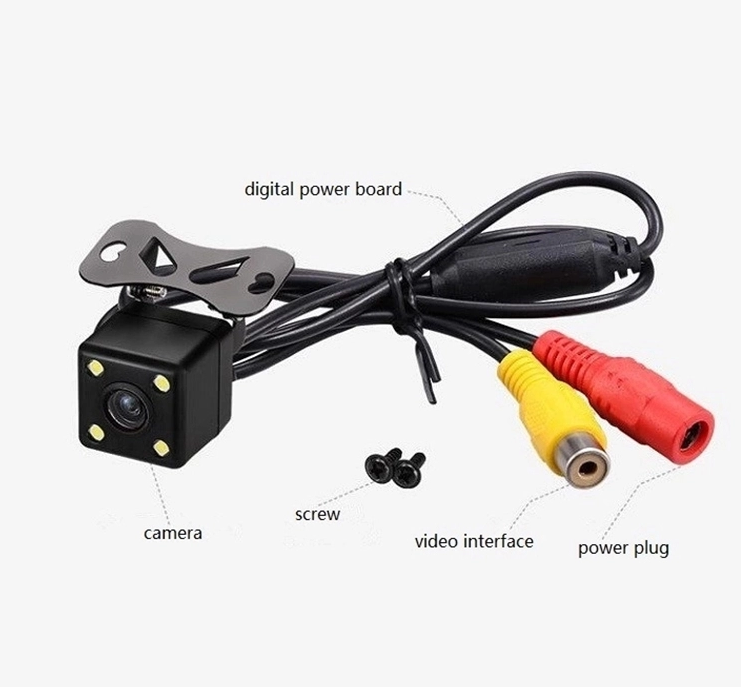
An RCA connector has a center contact and an outer contact. In a vehicle-camera video connection, they carry the video signal and its return. The familiar yellow plug is often used for video, but color alone is not a wiring specification.
The camera commonly receives power through a separate plug or lead. A red connector in a supplied camera harness may be a power connection rather than an RCA audio input. Follow the labeled assembly and wiring document, not color assumptions.
An RCA socket on a display does not establish which signal it accepts. Confirm the camera output and the receiving input, including any selected video mode.
What Is a 4-Pin Aviation Connector?
In this context, the term usually describes a circular four-contact camera connector with a retaining mechanism, often a threaded collar. A matched harness can carry video and supply connections through one assembly; some configurations also carry audio.
It is not a unified pinout standard. Contact numbering, polarity, thread dimensions, keying and electrical assignments can differ between suppliers. The term does not establish aviation certification or environmental performance either.
Ask for the exact connector drawing and camera-to-monitor wiring diagram. A photograph and the words “4-pin” are insufficient to approve a replacement cable.
How Are Power, Video, Ground and Audio Carried?
These functions must be checked individually. Do not assume a particular pin number performs a particular function.
- Power: confirm the camera's allowed supply, polarity and current requirement, and what the monitor or separate supply actually provides. A truck's electrical system does not automatically match the camera's input requirement.
- Video: identify the camera output, required signal return and receiving monitor format.
- Ground: confirm power return, video return and any shielding arrangement in the supplied drawing. Do not assume every return or shield is interchangeable.
- Audio: confirm whether the camera has a microphone, whether the harness carries audio, and whether the monitor receives it. A fourth contact does not prove audio support.
A reverse-trigger lead may serve a display-switching function rather than camera power. Its role must be identified separately in the installation instructions.
Does Locking Improve Vibration Resistance?
A retaining collar can help prevent an appropriately mated connection from separating. That makes a matched locking harness worth considering on trucks and buses, where routing and mechanical support are part of the installation.
Locking alone does not prove a vibration rating. Secure the cable so its weight does not pull on the connector, provide strain relief, and follow the supplier's mating instructions. Ordinary friction-fit RCA joints need suitable retention and protection in their actual mounting location.
Does a 4-Pin Connection Provide Better Weather Sealing?
Some aviation-style assemblies include seals, but the connector name does not establish an IP rating. Protection depends on the correct mating pair, intact seals, cable entries and the completed installation.
Do not transfer a camera housing's waterproof rating to its connectors, adapter or monitor. Ordinary RCA connections should be housed in an appropriate protected location or a verified protective assembly. For exposed rear or side connections, request the supplied assembly's protection details and inspect the installed joints. The IP67 vs IP69K Guide explains the distinction between a housing rating and installation protection.
Can You Convert a 4-Pin Camera to RCA?
Yes, if a correctly wired adapter supports the exact camera and receiving equipment. A passive breakout can route video to RCA and provide separate supply connections, but it does not convert AHD to CVBS or regulate voltage.
Before selecting an adapter, confirm:
- Connector gender, keying, thread and mating dimensions.
- Camera, adapter and monitor pin assignments, including the drawing's viewing direction.
- Video output and monitor input format.
- Supply voltage, polarity, ground and any audio path.
- Cable suitability, locking and protection at every new joint.
If the signal formats differ, a suitable active converter or an explicitly supported camera output mode may be necessary. A different plug cannot solve that mismatch. Changing an output mode is valid only when documented for the exact camera.
Why Does Physical Fit Not Guarantee Compatibility?
Two connectors can mate while connecting power to the wrong contact or delivering video to an input that cannot decode it. The result may be no image, intermittent operation or equipment damage.
Compare the complete electrical path before applying power. Reusing an existing vehicle cable is reasonable only after its connections and condition are verified against the new equipment. A working picture in one configuration does not approve every other camera sold with the same connector shape.
Why Can 4-Pin Pinouts Differ?
Manufacturers may use different contact assignments within similar-looking housings. Even diagrams can be misread when one shows the mating face and another shows the wire side.
Obtain labeled drawings for both ends and the adapter, with pin numbers and viewing direction. Have a qualified installer check an unpowered harness against those drawings when necessary. Wire color and plug appearance should not substitute for documented assignments.
No universal numbered pinout is supplied in this guide. Use the drawing for the quoted model and harness revision, and repeat the review if the supplier or configuration changes.
Does the Connector Determine AHD or CVBS Compatibility?
No. AHD and CVBS describe video signals; 4-pin and RCA describe connections. Equipment using either connector can still require a specific input format.
Match the exact output mode to the monitor's supported input, including resolution, frame rate and applicable PAL/NTSC settings. AHD support must be confirmed for the actual receiving channel; an RCA input or “AV input” label alone does not establish it.
Read the AHD vs CVBS Guide before choosing the camera, display and adapter combination.
What Connector Is Used for Truck and Bus Backup Cameras?
Truck and bus projects often evaluate locking multi-contact harnesses, but RCA and other model-specific connections are also used. The appropriate choice depends on the receiving display, cable route, exposure and maintenance needs rather than the vehicle label alone.
For a fleet, specify the connector and harness revision alongside the camera and monitor. Review rear and side runs separately, including any trailer disconnect, protected junction and service access. Validate the longest intended cable run and the installed display mode on a representative vehicle.
The Truck Backup Camera Guide covers rear-view selection. The Commercial Vehicle Camera Guide helps coordinate multiple cameras, displays and installation requirements.
Related Vehicle Cameras, Monitors and Cables
The supplied specifications list connector options for these cameras and monitor. They are selection candidates, not a pre-approved compatible kit. Confirm the ordered version and complete wiring path; no universal pinout or camera-to-monitor pairing is asserted.
How Should You Select the Cable Assembly?
Start with the camera category and monitor category, then review Camera + Monitor Systems for assemblies that include cabling. Confirm the actual harness, adapter, length and end connections in the project quotation.
There is no verified standalone cable SKU or separate cable category included here. For a replacement or custom run, request a matched cable assembly using the camera and monitor models and their wiring drawings. Do not treat an unlisted “universal 4-pin cable” as an approved substitute.
Frequently asked questions
Is 4-pin better than RCA for vehicle cameras?
A matched locking 4-pin assembly may simplify wiring and help retain the joint. RCA can suit an existing compatible display. Choose by the complete wiring, mechanical support and exposure requirements; neither connector is universally better.
Can a 4-pin camera connect to an RCA monitor?
It can when the adapter's pinout, supply connections and video path match the camera and monitor. A passive adapter does not change the signal format or regulate the supply. Confirm the monitor accepts the exact camera output.
Can two connectors that physically fit still be incompatible?
Yes. Contact assignments, voltage, polarity, audio and video formats may differ. Verify the wiring and receiving input before powering the assembly.
Do all 4-pin aviation cameras use the same pinout?
No. The name does not establish a unified wiring standard. Request the model-specific drawing with pin numbers and mating-face or wire-side orientation.
Does RCA mean the camera uses CVBS?
No. The connector shape alone does not identify the video signal. Check the camera's selected output and the monitor's supported input modes.
Are 4-pin aviation connectors waterproof?
Only the specified assembly's documented protection can answer that question. Check seals, mating parts and cable entries; a camera housing rating does not establish a connector or installation rating.
Does a four-contact connector guarantee audio?
No. Audio requires a supporting camera, assigned wiring and a compatible receiving input. Confirm these separately; do not infer a microphone from the contact count.
Can a camera connect directly to the truck's power supply?
Only if the documented camera supply requirements and installation instructions allow that connection. Confirm voltage, polarity, protection and the actual source. Connector shape does not determine an acceptable supply.
Technical References
- AutoChimp: Heavy Duty 4-pin to RCA adapter identifies a passive adapter that neither converts AHD to CVBS nor regulates voltage, and calls for matching pinout, voltage and video format.
- Safety Dave: RCA adaptors distinguishes connector adaptation from an AHD-to-standard-definition converter in its own product range.
These are examples of supplier-specific hardware, not compatibility approvals for SuperPower products. The related-product details above come from the supplied model specifications; pin numbering, adapter mapping and assembly protection still require confirmation for the quotation.